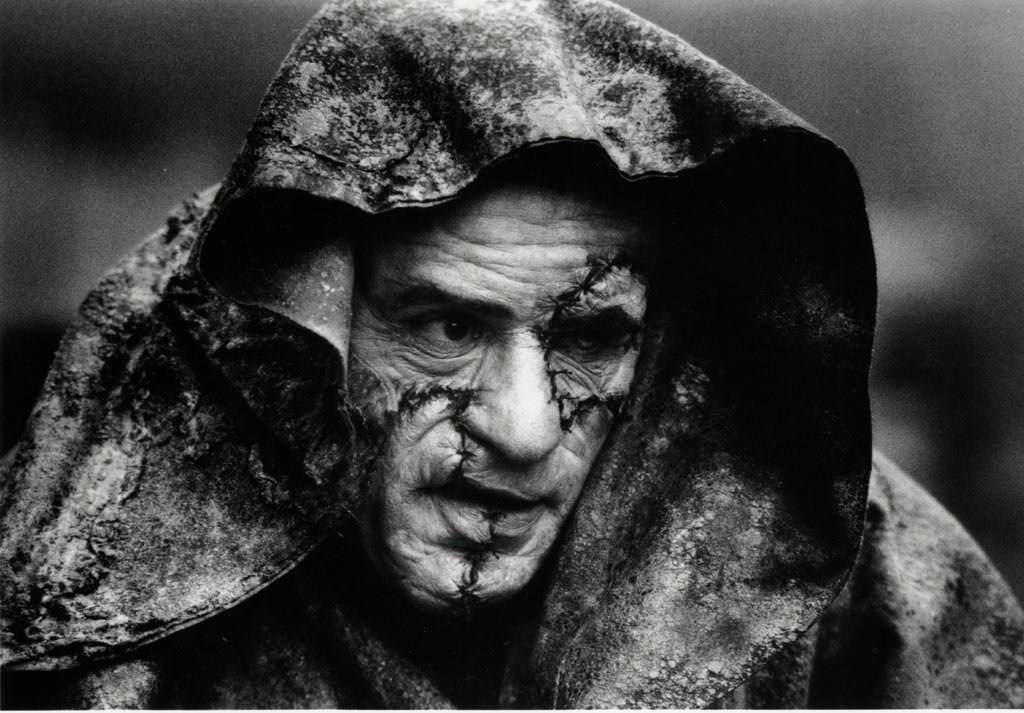
A lesson in sass for my students
The following paragraph was written as a sample for my English 12 AP students when they were learning about finding their voices in writing. I was trying to move them away from technical perfection and toward authentic voice in writing. This is what I came up with. Enjoy.
Writing Prompt: Write a well supported paragraph discussing the following:
- One essential Question: How do people react to consequences?
- One character: The Monster
- One conflict or moral dilemma that reflects your essential question: The monster does not get his way and therefore goes on a killing spree to get revenge.
- Use C.S. Lewis article from Mere Christianity, excerpt from Paradise Lost, Genesis 3, and Ezekiel 28 to piece together a moral stance on the dilemma. You must choose to either support or condemn the character’s choice/actions. There is no middle ground. The monster is not justified in killing anyone. He knows it is wrong.
Being ugly and lonely is not a license to kill. If it were, there would be a massacre every night in Walmart around 2:00 A.M. In Mary Shelley’s Frankenstein, Victor Frankenstein’s creation, referred to as “the monster,” attempts to justify his homicidal spree by blaming his creator for abandoning him in his time of need. The monster rationalizes that he was loving and benevolent before Victor denied him the one thing he needed, a companion. The monster claims, “[He] was a slave, not the master of impulse, which [he] detested, yet could not disobey” (Shelley, 153). However, the monster had already killed William and thus, can’t claim loving benevolence prior to his request for a mate. Earlier in the novel, while acclimating to becoming an awkward sub-human, the monster develops a chip on his shoulder after being abandoned by Victor. He has a hard life. But who doesn’t? Apparently, the monster was equipped with the brain of a narcissistic psychopath who is incapable of applying his knowledge to something useful. Instead, he creeps around cottages, lurks in dark corners, spies on unsuspecting families, and gives children nightmares. As many narcissistic psychopaths will, the monster always seems to be the victim of every circumstance he endures. He is alone, “…no Eve soothed [his] sorrows, or shared [his] thoughts;… I remembered Adam’s supplication to his Creator; but where was mine? He had abandoned me, and, in the bitterness of my heart, I cursed him” (Shelley, 88). Well someone call the wah-mbulence. In a strangely rational conversation, following the murder of Victor’s brother William, the monster gaslights Victor into believing he is partially at fault for William’s death, but that he will do better if Victor will make him a sidekick. The monster argues, “If I have no ties and no affections, hatred and vice must be my portion; the love of another will destroy the cause of my crimes,…” “My vices are the children of a forced solitude that I abhor; and my virtues will necessarily arise when I live in communion with an equal” (Shelley, 100). As a result of being denied, the monster gives Victor an ultimatum to comply with his conditions if he wants peace, but if he refuses, the monster will “glut the maw of death until it be satiated with the blood of [his] remaining friends (Shelley, 65). When Victor is clearly clinging to his newfound morals, the monster declares his intentions, “Remember that I have power, you believe yourself miserable, but I can make you so wretched that the light of day will be hateful to you. You are my creator, but I am your master,-obey!” (Shelley, 116). Seeing that Frankenstein will not be moved on the issue, the monster vows, “You can blast my other passions, but revenge remains–revenge, henceforth dearer than light or food!”(Shelley, 116). At this point, Frankenstein’s monster goes on a killing spree and continues to blame Victor for creating him in such a way that he has no choice but to kill. Through Shelley’s use of allusion, the monster continually equates himself to the biblical Adam after reading Milton’s Paradise Lost. Milton’s Adam is repulsed by his own sin and laments the fact that “For one man’s fault thus guiltless be condemn’d, if guiltless” (Book 10, lines 23-24). Victor’s “Adam” laments, “Am I to be thought the only criminal, when all human kind sinned against me?” (155). The two are not the same. In Genesis 3, the biblical Adam blames Eve immediately for committing the ultimate sin at the time. Milton also depicts Adam as the innocent victim of Eve, “that bad woman,” who causes the downfall of mankind. Maybe Victor should have let the monster in on the trouble a mate would bring. Maybe by giving him a copy of “David and Bathsheba,” or the “Sampson and Delilah” story instead. The monster wanted a scapegoat, not a soulmate. The monster’s refusal to take responsibility could stem from his singular focus of revenge after Victor refuses to create a second abomination as he promised to do. C.S. Lewis might describe this as a failure to “practice ourselves the kind of behaviour we expect from other people” (Lewis, 3). The monster admits after the death of Frankenstein that he knew what he “ought to do, but didn’t do it” (Lewis, 4). He completely ignores his inborn Moral Law. In conclusion, ugly lonely people find love and belonging all the time. Any visit to a fraternity house will prove that point. There is never a justification to go all Michael Meyers while throwing an entitled Gothic tantrum because one has daddy issues. All the monster needed was a good Phantom of the Opera mask and a little patience. Even Quasimodo was able to figure it out while maintaining his dignity. Ultimately, Mary Shelley’s monster, in her disturbing masterpiece, Frankenstein, comes to the correct conclusion that he should stop killing and just light himself on fire.
Oct. 25, 2018. The Nuts and Bolts of Frankenstein’s Movie Monsters. https://www.nytimes.com/2018/10/25/movies/frankenstein-monster-movies.html
 joyinamadworld.com
Wow! That’s deep! Mom
Sent from my iPhone
>
LikeLiked by 1 person
Thank you!
LikeLiked by 1 person